Free tools / AI Citation Source Finder
Citation sources
Which sites does AI quote about your industry?
freeWhen an assistant answers a question in your field it quotes somewhere — review sites, directories, comparison pages, regulators. This tells you which ones, by name.
That list is where a mention of you would be read. It is a list of places to go, not a promise that going there changes an answer.
Find the sources
ChatGPT and Gemini · your own customer questions
This runs on our servers, not in your browser. A web page cannot ask ChatGPT a question on your behalf, so your website address is sent to us and we make the calls. Your result is yours: it is not published, not put in our public figures, and not used to train anything.
What a short list can mean
- domains found
- The assistants quoted these addresses while answering about your field. Each one is named, with what kind of site it is.
- none recorded
- The questions ran and no quotable address came back that was not already counted as a rival. That is a real finding, and it is not a zero on a score.
- not measured
- We could not establish it — the calls did not return, or the saved copy of the result is older than the field that holds this list. Reported with the reason, never as “none”.
The answers, in the app
Everything above describes what the assistants quoted. This is what a measured set of answers looks like — the paid product’s prompt-by-engine table, the app itself rendering its simulated Northlight scan. It is a deeper scan than the free check above, and the caption spells out the difference.
wider than this screen — slide it sideways
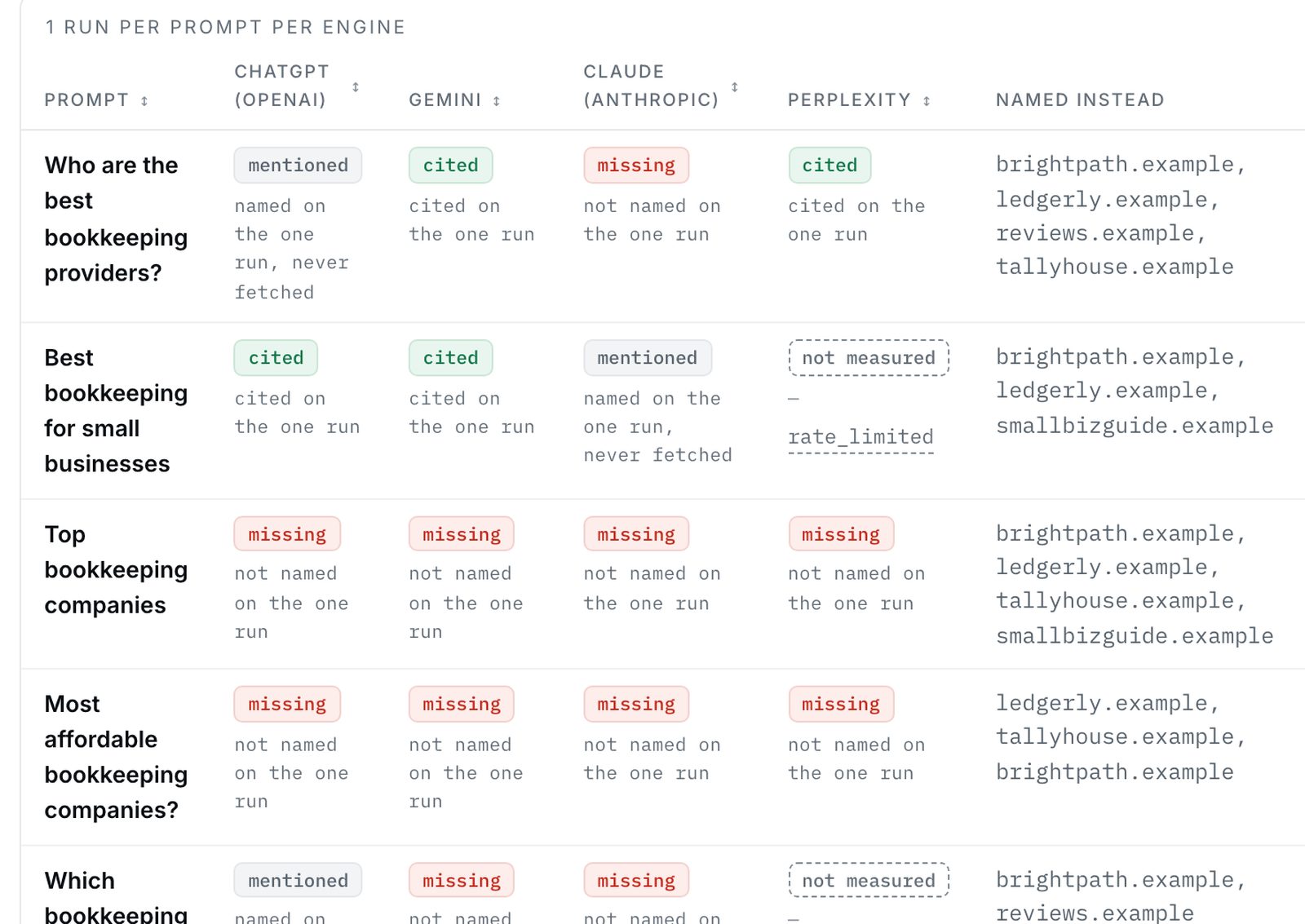
The distinction this page is built on
Quoted is not the same as named
An assistant can say a business name from memory, having read about it long ago and never opened the site. That is being named. Quoting is different: the answer carries a web address it actually fetched and used. This page is about the second one only.
Named from memory
The model produces a name because a name is in the model. No page was fetched, no address appears in the answer, and nothing you publish this week can be the reason. Useful to know, and not what this tool collects.
mentionedQuoted from a page
A web address turned up in the answer as a source, which means something fetched and read it. Those addresses are what this tool lists. They are the pages an assistant was willing to lean on when the question was about your field.
citedWhy the difference matters here: an outreach list built from names would be a list of businesses. A list built from quotes is a list of pages an assistant reads, which is a different and much shorter set. Merging the two would produce a longer list and a worse one.
Before you read a short list
Three different things, and none of them is a zero
A page whose whole subject is honesty about citations has to be careful with an empty list. There are three ways this page can have little to show you, they mean completely different things, and it says which one you are looking at.
They were quoted, and here they are
The ordinary case. Each address is listed with the kind of site it is — review or directory, reference, government, search or social, or a very large platform — and how many of your questions it turned up in.
domains foundThe questions ran and nothing was recorded
The calls came back and carried no quotable address beyond the ones already counted as rivals. This one is worth reading twice: the list is only collected from answers where your site was not the thing being quoted, so a business that gets quoted itself will see a short list here for a good reason.
none recordedThe record cannot answer the question
Results saved before this field existed read back empty whatever was really quoted, because there was nowhere to put it. That is a gap in what we stored, not a finding about you, and it is shown as not measured with that reason rather than as an empty list.
not measuredThe same rule covers a call that never came back, an assistant that refused the question, and a day when we have stopped spending: every one of those is reported as not measured with its reason and is left out of every count. A check that did not happen is not a finding that nothing is there.
Made up, and labelled
What the list looks like
This is an invented business with invented results, so you can see the shape before you run anything. The addresses below use the .example ending, which cannot be registered by anyone — nothing here is a real site and nothing here is a real measurement.
Northlight — northlight.example
EXAMPLE DATAFive addresses were quoted across eight questions.
Collected from the answers where Northlight itself was not the thing being quoted. Each row says what kind of site it is and how many of the questions it turned up in.
Eight questions · ChatGPT and Gemini · each question asked once · this is one pass, and one pass is a snapshot rather than a trend
- review-site-one.example a review, directory or comparison site 5 of 8 questions
- software-directory.example a review, directory or comparison site 4 of 8 questions
- buyers-guide.example a review, directory or comparison site 2 of 8 questions
- public-agency.example a government site 2 of 8 questions
- encyclopedia.example a reference site 1 of 8 questions
Read it as a list of places to look at, in the order the assistants reached for them. Three of the five are the kind of page that takes submissions, listings or corrections. One is a regulator. One is an encyclopedia. What you do about each is a different job, and none of it is something this page can promise an outcome for.
Two more addresses were quoted in the same answers and are not on this list: the scan counted those as possible rivals and reports them separately, under competitors. A domain is on exactly one of the two lists, never both and never neither.
The rest of the shelf
Free tools that work on the same site
A list of pages an assistant reads is only worth having if an assistant can also read yours. These four are free, and answer the questions that sit either side of this one.
AI Visibility Checker
The full version of the check behind this page: whether the assistants name you at all, on which questions, and who gets named in your place.
freeAI Crawler Checker
Whether one line in one file is quietly telling the AI crawlers to stay off your site. Plenty of businesses are blocking them by accident.
freeRender Check
Whether your pages look empty to something that does not run JavaScript. A page that reads as blank is a page nothing can quote.
freeAI Readiness Score
Crawler access, page structure, machine-readable facts and clean HTML in one pass, with the unrun checks left out of the arithmetic.
freeFour more run entirely in your browser and send us nothing at all: the FAQ Schema Generator, the Organization Schema Generator, the llms.txt Generator and the robots.txt Generator. There is also the AI bot list, which is a reference page and asks for nothing.
Fair questions.
What do I have to type in?
Your website address, and nothing else. We read your homepage to work out what you sell, and the questions follow from that.
Where does the list come from?
From the answers themselves. Each question goes to the assistants, and their answers carry the web addresses they used as sources. We take those addresses, drop your own, set aside the ones that look like rivals, and list what is left with the kind of site each one is.
So it is a record of what was quoted while your field was being discussed. It is not a ranking of those sites, and nothing about their quality was measured.
Why is my list short or empty?
Three possibilities, and the page tells you which. Either the answers genuinely carried nothing quotable beyond the rivals — which is exactly what happens when a business gets quoted itself, because the list is only collected from the answers where your own site was not the source. Or a check did not come back, in which case it says so with the reason. Or the saved copy of a result is older than the field that holds this list, in which case it cannot answer the question at all and says that instead of showing you an empty list.
Which assistants do you ask, and how many times?
ChatGPT and Gemini, and each question is put once. One pass is a snapshot, not a trend line, and this page says so beside every result rather than dressing a single run up as a rate. Asking the same question repeatedly and reporting the spread is what the paid plans add. Perplexity is on Pro, asked every third day. Google’s AI Overviews is on Pro. The route to it is a paid search-data vendor and we now buy that data. It has not yet run against that vendor for real, so no figure from it appears anywhere until it has.
If I get onto these sites, will AI quote me?
Nobody can tell you that, and anyone who does is guessing. What this page gives you is a list of the pages assistants were actually willing to read when the subject was your field. What you do with it — a listing, a correction, a pitch, a comparison page of your own — is ordinary work with ordinary odds. We do not control what a model says and we will not sell you an outcome we cannot deliver.
Who sees my result?
You do. The domains you were shown, the questions we asked and where you stand are not published, not folded into our public figures, and not used to train anything, unless you separately say yes to that in its own place. It will never be buried in a terms-of-use box.
The list is the easy half. Being on it is the work.
You now know which sites the assistants reached for on these questions. The narrower question is the one about you: on the questions your own customers type, are you named at all — and if not, who is named instead? Same method, pointed at your domain. Up to five questions written from your own homepage, put to ChatGPT and Gemini, once each.