Free tools / AI Visibility Checker
The main check
Does AI mention your business?
freeAsk ChatGPT or Gemini to recommend a business like yours and it names a few. This tells you whether one of them is you — and, when it is not, exactly who took the slot.
Check your website
up to 5 questions · ChatGPT and Gemini · asked once each
1
We read your website to work out what you sell and where you are.
2
We write up to five questions a customer of yours would actually type — and show them to you before we go.
3
We ask ChatGPT and Gemini those questions, and read the answers to see if you are in them.
This check runs on our servers, and it has to. A web browser cannot ask ChatGPT a question on your behalf. The four generators further down genuinely do run in your browser, and only those say so.
Northlight
example.com EXAMPLE DATA4 of 4
Named in
≥1 measured answer
2 of 4
Cited
Gemini checks · ChatGPT was not asked to look
2
Mentioned only
from model memory
1
Not measured
excluded from counts
| Prompt | ChatGPT | Gemini | Named instead |
|---|---|---|---|
| Best review software for contractors | mentioned | cited | — |
| Top review management providers | mentioned | missing | competitor-one.com |
| How much does review software cost? | missing | mentioned | competitor-two.com |
| Northlight vs alternatives | not measured | cited | — |
Four counts, kept apart, never summed. The unmeasured half of the last question is left out of every count rather than scored as a no. Named-in and cited carry different denominators on purpose: naming is counted over both assistants, citation only over the one that was asked to fetch.
What comes back
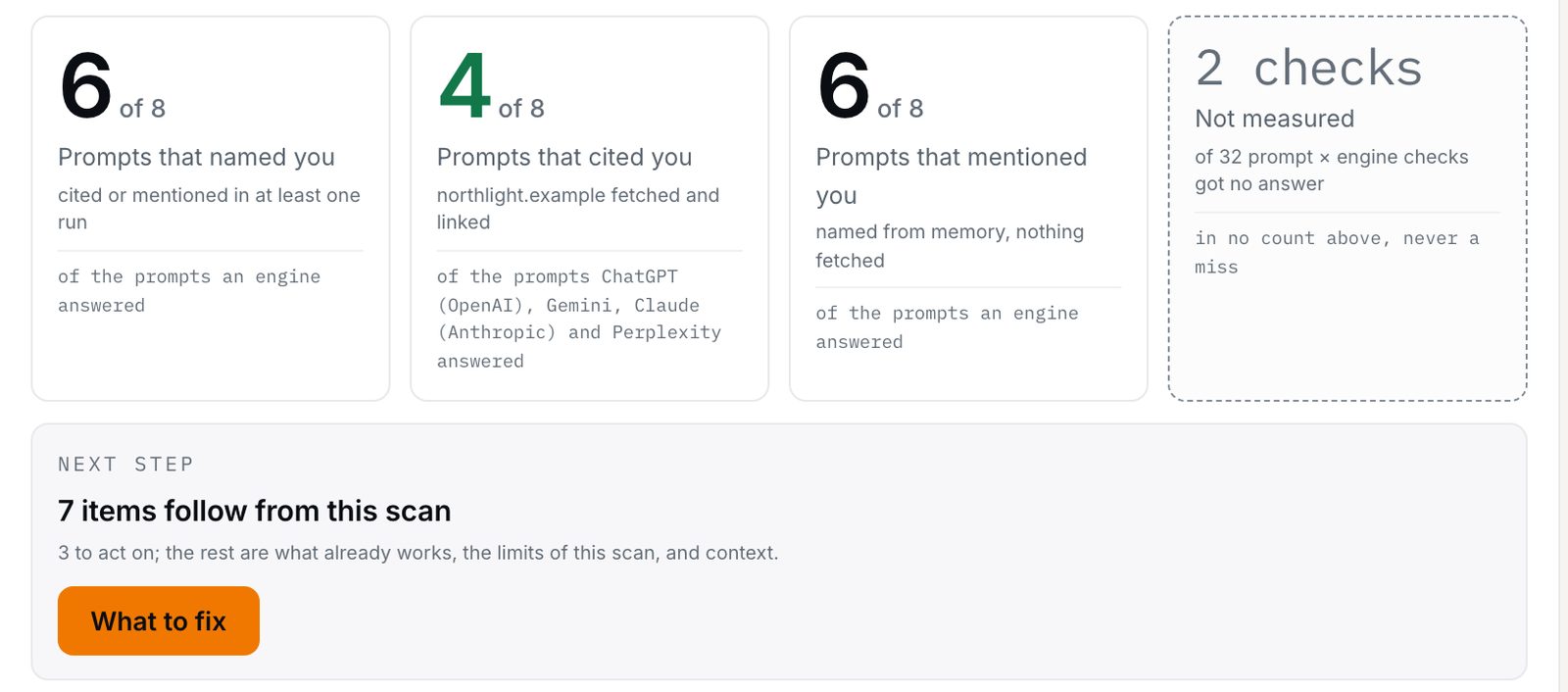
This is the screen a scan feeds — the real product, on an invented brand. It is a deeper scan than the free one above, and the caption spells out the difference.

Reading your result
Four things can happen for each question
Each question gets one of these four answers from each AI, and each one means something different for what you do next. The small grey words are the labels we use in the report; the sentence is the part that matters.
AI used your page as a source
The best outcome. The AI actually opened a page on your website and used it to answer the question. This is the only proof it read you rather than remembered you.
citedAI named you from memory, but didn’t use your page
It knows your name, but it did not go and read your site. Usually that means it cannot get to your pages, or your pages do not answer that particular question. Fixable, and a different job from being unknown.
mentionedYou weren’t in the answer at all
A real no. The useful part is who was named instead — that is the business you are being compared with, on that question, today.
missingWe couldn’t check that one
Our request did not get through — the AI was busy, or slow, or we hit a limit. We tell you which. It is never counted as a no, and it never counts against you anywhere in your result.
not measuredwhats the best crm for a small law firm
For a small law firm, the options that come up most often are:
1. competitor-one.com
matter management and trust accounting built in
2. competitor-two.com
cheapest of the three, with a client portal
3. competitor-three.com
strongest document automation
What you get back
A worked example, start to finish
This is a made-up coffee roaster, so you can see the shape of a real result before you run one. Every number here is invented for illustration.
Fern & Kettle Coffee — fernkettle.example
EXAMPLE DATAFern & Kettle was named in 2 of the 3 questions we asked.
We asked Gemini to go and look on 3 questions. On 2 of those it used a page on your website as a source — that is the part that proves it found you rather than remembered you.
ChatGPT answered from what it already knows and was never asked to fetch anything, so whether it read your site is not measured on this check — not a no, not a zero, and not counted in the number above.
1 check could not be completed. That is one question put to one assistant, not a whole question — and it is not a no. We could not get an answer, so it is left out rather than counted against the business.
example figures · each question asked once per AI · not a measurement of any real business
“which coffee subscription is best for a small office?”
ChatGPT named you. Whether it used a page of your site as a source was not measured here — that is not a no.
mentionedGemini used your page as a source.
citedWhat to do: nothing on your side. One assistant used a page of your site as a source here, which is what you want. The other named you without being asked to go and look, so that half is not measured — not a no, and nothing has been counted against you.
“where can I buy freshly roasted coffee beans near me?”
You weren’t in ChatGPT’s answer. competitor-one.com was.
missingYou weren’t in Gemini’s answer. competitor-one.com and competitor-two.com were named on this question.
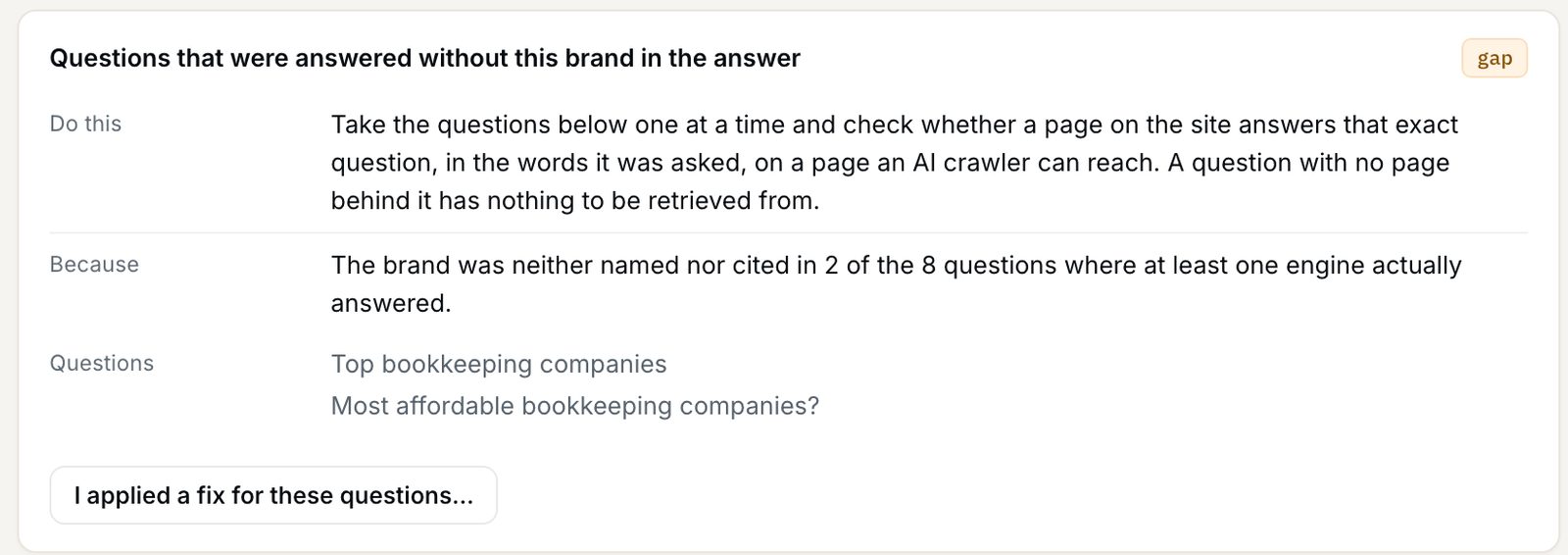
missingWhat to do: put a page on your site that answers this exact question in your own words — where you are, what you sell, what it costs. Right now competitor-one.com has one and you do not.
“how much should good coffee beans cost per kilo?”
We couldn’t check ChatGPT for this one — it limited how many questions we could ask in a row.
not measuredGemini used your page as a source.
citedWhat to do: nothing on your side. The ChatGPT half did not run, so we have left it out instead of scoring it as a miss.
And what you do about it
The finding is half of it. In the app, a miss becomes an item like this — what to do and why, with the customer questions it came from.
wider than this screen — slide it sideways
What we will not do
No score out of 100, and no promises
Two things you will see on other sites in this category, and will never see on a visibility result. Our free site checks do score a page out of 100 — a page either has a heading or it does not, and that answer does not change between runs. What an assistant says about you does, which is why no number stands in for it here.
We give you a count, not a score
Your result is a plain count: named in 2 of the 5 questions we asked — one snapshot of what these two AIs said on the day.
A score out of a hundred cannot be checked by you, or by us. It is a number we would have made up, and asking an AI the same question twice can give two different answers — so any decimal point in it would be fiction.
The free check asks each question once, so each answer is one sample rather than a rate. We say so on the result instead of dressing it up as a percentage.
Nobody can promise you a mention
Not us, not anyone. We can show you where you are missing, who is being named instead, and hand you the schema, robots and llms.txt files that make your site readable to an AI in the first place. We cannot make an AI say your name, and any company telling you otherwise is selling you something they do not control.
This free check does not cover Google’s AI Overviews — the answers at the top of Google. Google publishes no way to ask for them, so the only route is a paid search-data vendor. That route is on Pro, and it has not yet run against that vendor for real — so no figure from it appears anywhere, on any plan, until it has.
2 of 5
named in 2 of the 5 questions we asked
Four counts, kept apart. Adding them together is the number we refuse to print — and the one that would be easiest to sell.
Working today
Seven things you can use right now
All seven are finished and free. None of them measures whether AI mentions you — only asking the AIs does that — but each one fixes or checks something that has to be right before an AI can find and quote you. The four generators run in your browser:
FAQ Schema Generator
Turn your questions and answers into a small block of text an AI can read cleanly. Paste it into your site, or hand it to whoever built it.
free · runs in your browserOrganization Schema Generator
Tell AI who you are: your real name, where you are, your official profiles. Stops it confusing you with a business that has a similar name.
free · runs in your browserrobots.txt Generator
One small file that decides which AI companies are allowed to read your site. Plenty of businesses are blocking them all by accident.
free · runs in your browserllms.txt Generator
A short summary of your site, written for AI to read. Worth an hour — though no AI company has confirmed they use it, and we will not pretend otherwise.
free · runs in your browserThree more free checks fetch your pages from our server and hand you back what an assistant gets: the AI Crawler Checker (whether you are accidentally blocking AI from reading your site), the Render Check (whether your pages look empty to AI), and the AI Readiness Score (all of the above in one pass).
Fair questions.
- cited
- A page on your site was fetched and used as a source.
- mentioned
- Named from model memory. Your site did nothing.
- missing
- The answer ran and never named you. Someone else got the recommendation.
- not measured
- The check did not return. Reported with its reason and left out of every count.
What do I have to type in?
Your website address, and nothing else. If you know what your site is called — yourbusiness.com — you have everything you need.
What is the difference between “used your page” and “named you”?
“Named you” means the AI said your business name in its answer. It can do that from memory, from an old article, or from a competitor’s comparison page, without ever opening your website.
“Used your page” means your own web address turned up in the answer’s list of sources — proof that a page of yours was actually read. They are two different situations with two different fixes, so we keep them apart instead of merging them into one number.
Which AI assistants do you check, and how many questions?
The free check asks up to five questions across two assistants, ChatGPT and Gemini, once each — as many questions as your homepage supports, and the result says how many it asked. Repeating the same question several times and averaging the result is on the paid plans. Perplexity is on Pro, asked every third day. Google’s AI Overviews is on Pro. The route to it is a paid search-data vendor and we now buy that data. It has not yet run against that vendor for real, so no figure from it appears anywhere until it has.
Why don’t you give me a score out of 100?
Because we would be making it up. AI answers change from one run to the next, so a score with a decimal point in it would look precise and mean nothing. You get a count instead — named in three of the questions we asked — which is one snapshot rather than a rate. Because the answers move run to run, a single count is not a trend line; watching it move is what repeated runs on a paid plan are for.
Can you promise AI will mention my business?
No, and neither can anyone else. We show you where you are missing, who is being named instead, and what to change. Whether an AI then names you is its decision, not ours.
Who sees my results?
You do, and anyone you give the link to. Your check — your business, your competitors, and where you are losing — is not published, not used in our public data, and not used to train anything, unless you separately say yes. It will never be buried in a terms-of-use box.
The result comes with a link so you can come back to it or send it on. That link is a key rather than a password: it is not indexed and not listed anywhere, but whoever holds it can open the headline without signing in — so share it on purpose. It expires, and the date is printed next to it.
You cannot make an AI name you. You can make yourself readable.
One check is one day. An answer that moves is the reading-and-fixing part done again, and a second run to compare it against — the same questions asked again on a schedule, with the previous period beside them. That is what the plans are for. The pricing page lays out exactly what each one includes.
Shopping around is the sane thing to do here: eight vendors compared, every price read off the vendor’s own page and dated, with a section on when one of them is the better buy. Or keep going for free — the AI Readiness Score takes your own site apart check by check.