Free tools / llms-txt-generator
FREE TOOL · RUNS IN YOUR BROWSER
llms.txt Generator
A short summary of your site, written for AI to read. Fill in the form and you get one small file to upload. Read the box below before you spend the hour.
Read this before you use it
No major AI company has publicly confirmed that it reads this file. Not OpenAI, not Anthropic, not Google, not Perplexity. Google has gone further and published the opposite: its Search documentation states that llms.txt files are not needed for Google Search and will neither help nor hurt your visibility there. Independent evidence agrees — a study of 137,000 domains found that 28% publish the file and 97% of valid files received no requests at all in the month measured.
So this generator does not tell you the file will get you into AI answers. It cannot. Any page that implies otherwise is stating something no AI company has confirmed. What it actually is: a suggested convention, published at llmstxt.org by Jeremy Howard of Answer.AI in September 2024. It costs about an hour, you can delete it at any time, and writing it forces a genuinely useful audit of your own pages. That is the honest case for it, and it is a reasonable one.
Your file
0 linksthe grey text in each box below is an example — type your own, and anything left empty is left out of the file
llms.txt
Save as llms.txt at the very top of your site — https://yourdomain.com/llms.txt, served as plain text.
What we checked
Generation runs entirely in your browser. What you type here is not sent anywhere. (checkable — open your network tab: nothing you type appears in any request. The page itself loads fonts and WordPress assets, like every page here.)
What comes out
Not what the plate above prints before you type — this is that same plate, photographed once every box was filled in for an invented business.
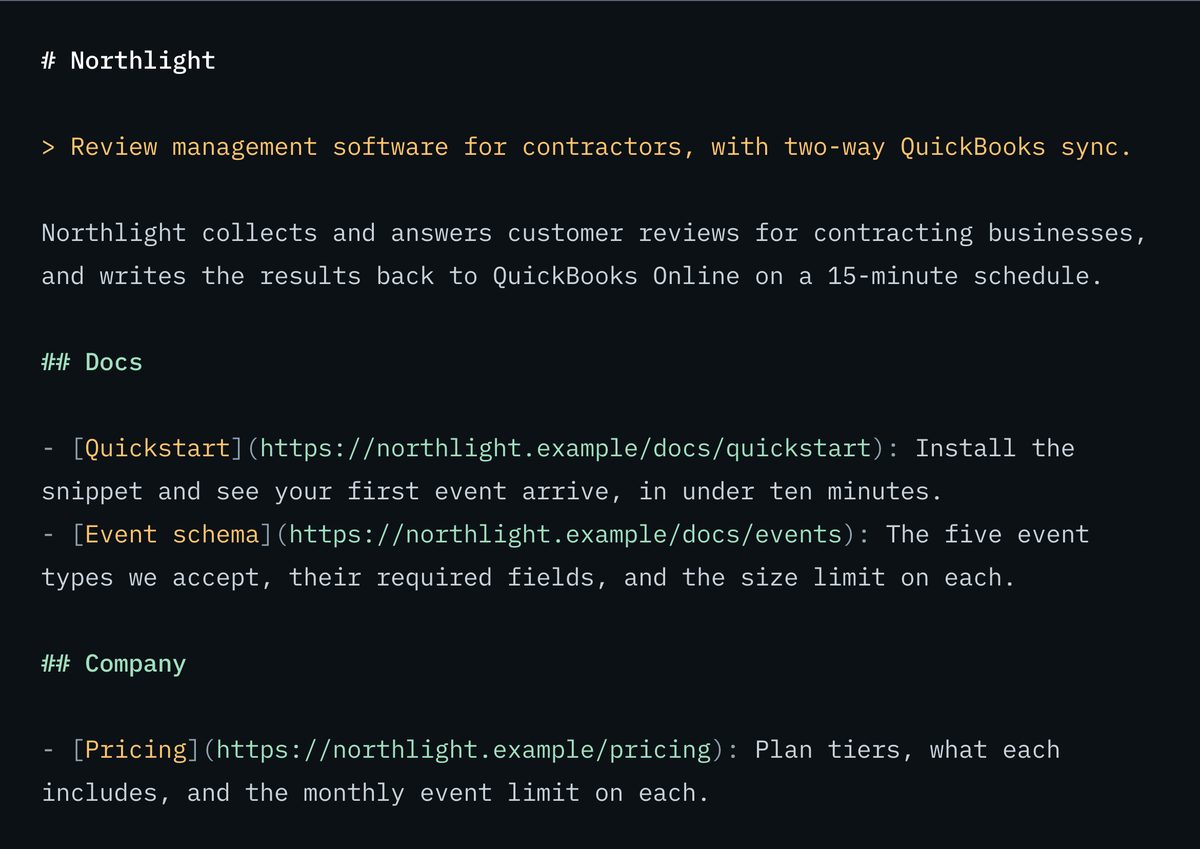
WHAT IT ACTUALLY IS
A small text file at the top of your site, with four parts
A plain text file sitting at https://yourdomain.com/llms.txt:
- A heading with your site or product name. This is the only part that is required.
- One or two sentences directly underneath, saying what this site is.
- Optionally a little more explanation, then a few headed sections, each holding a list of links written as
- [Title](address): one-line description. - By convention, a section called
## Optionalat the end, for links that can be skipped when a shorter version is needed.
# Northwind Analytics

> Self-serve product analytics for small SaaS teams.

## Docs

- [Quickstart](https://northwind.example/docs/quickstart): Install the snippet and see your first event arrive.
- [Event schema](https://northwind.example/docs/events): The five event types we accept and their limits.

## Optional

- [Changelog](https://northwind.example/changelog): What shipped, newest first.
This is the shape the builder above writes. Fictional site, real structure.
There is also a fuller version — the same idea, but with the whole text of each page written into the file rather than linked to. This tool makes the linked version; the full one is a job for whoever builds your site, not for a form.
THE ONE LINE THAT CARRIES THE WORK
Three small files, three different jobs
They get confused constantly. The fourth card is why building this one is worth an hour even given the warning at the top of this page.
01
robots.txt — who is allowed in
Lets companies in or keeps them out, and the well-behaved ones obey it. Check yours against the AI companies.
02
sitemap.xml — everything you have
A machine-written list of every page worth listing. Exhaustive by design.
03
llms.txt — the shortlist
Short and hand-picked: the pages you would hand someone who had thirty seconds. Being exhaustive is the failure here, not the goal.
04
The audit is the real payoff
Listing your real pages and saying what each one is for surfaces the duplicates, the ones nothing links to, and the four pages that all half-answer the same question. That is worth having whether or not an AI company ever reads the file.
The description line is the whole file
- Everything else is plumbing. A list of links with no descriptions is just a worse version of a sitemap.
- The description is the only part carrying something a machine cannot work out from the web address itself.
- The useful version answers what question this page settles, not what the page is called.
- Write each line so it makes sense to someone who has seen nothing else on your site.
- [Pricing](/pricing): Our pricing page.- [Pricing](/pricing): Plan tiers, what each includes, and the per-scan limits on each.WHAT THIS FILE CANNOT DO
We'd rather tell you the limit
than sell you the file.
The maintenance trap
This file is accurate the day you write it and a liability six months later. Links rot, pages move, and descriptions describe a product you no longer sell.
A file confidently describing pages that no longer exist is worse than no file at all — it is the one thing here that can actively mislead a reader, human or machine. Either have it rebuilt automatically, or put a recurring reminder in your calendar and re-check every link in it by hand. A file you never revisit is the one that will embarrass you.
Limitations, stated plainly
This tool checks how the file you are typing is put together, not whether it is true — it cannot tell you a description is wrong, and it cannot tell you a link works, because it never opens one. Building the file happens inside your own browser and is private; checking a live file would fetch a public file from our server and would not be, which is why the two are kept apart on this page rather than blended together.
And to repeat what this page opened with: publishing this file is not known to improve your visibility with any AI assistant, because no AI company has said it reads one. Anyone selling you the file as a way to get mentioned is selling you a claim nobody can support.
FAQ
Fair questions.
We use our own tools on this page.
Does llms.txt actually work? Do AI assistants read it?
No major AI company has publicly confirmed reading it. There is no documentation saying it is used, and nobody has shown it happening. Treat it as a cheap, reversible convention that some teams have adopted, not as something with evidence behind it. If that changes, this page changes.
Then why would I publish one?
Three defensible reasons, none of them a promise about rankings: it costs about an hour, you can delete it in a minute, and writing it forces a genuinely useful audit of which of your pages are the real ones and what each is actually for. If the convention does get taken up later, you already have the file. That is the whole argument.
Where does the file go?
At the very top of your site: https://yourdomain.com/llms.txt, served as plain text and actually reachable. Not in a subfolder, not behind a chain of redirects. One per website.
Is my data sent anywhere when I use this?
No. This tool runs entirely inside your own browser tab — nothing you type in the form leaves the page, and you can confirm that in your browser's network panel. The page calls nothing at all.
What is the difference between llms.txt and llms-full.txt?
The first links to your pages with a description for each. The second writes the actual text of those pages into one long file. The full version goes stale faster and gets large quickly, so it suits documentation sites that can rebuild it automatically. This tool makes the linked version.
A FILE NOBODY HAS CONFIRMED READING IS NOT A STRATEGY
Check the things an assistant
demonstrably does read.
Your robots.txt, the HTML your server hands back, the schema on the page. The AI Readiness Score fetches your page from our server and takes all three apart, finding by finding.