How it works
How we check whether AI answers name your business.
When one of your customers asks ChatGPT or Gemini something like “which brands make the best waterproof hiking boots”, the reply names a handful of brands. Either you are one of them, or you are not. This page walks through exactly how we find that out.
12 of 18
Named in
measured answers
5
Cited
page opened + linked
7
Mentioned only
from model memory
2
Not measured
excluded from counts
| Question | ChatGPT | Gemini | Named instead |
|---|---|---|---|
| Best review software for contractors | cited | cited | — |
| Top review management providers | mentioned | missing | competitor-one.com |
| How much does review software cost? | missing | mentioned | competitor-two.com |
| Is yourbusiness.co.uk any good? | not measured | cited | — |
What we actually do
Three things. That is the whole idea.
Whole sentences, asked the way your customers ask them — then one honest line written down per question.
-
01
We write down the questions your customers would ask
Whole sentences, the way people really type them — “best family solicitor in Bristol”, “is [your business] any good” — not single words.
-
02
We ask those questions and read the answers
We put each question to the AI assistants your customers use, and read what comes back.
-
03
We write down one thing per question
Were you named — and if you were, did the assistant actually open your website, or was it going from memory, the way a person half-remembers a shop?
01best crm for small law firms
02top review management providers
03how much does review software cost?
04is yourbusiness.co.uk any good?
Inside one answer
It either opened your website, or it did not.
An assistant naming you from memory and an assistant opening your website and quoting it are two different events with two different causes. Only one of them is something your website can be credited or blamed for — so we never add the two together.
Your customer asked
“best crm for small law firms”
ChatGPT
What it did
Opened yourbusiness.co.uk while writing the answer
A page of yours was fetched, and the answer pointed back at it.
So the result is
cited1 of 1 run
Your own page did the work, and we can point at the page that did it.
Gemini
What it did
Answered from memory — nothing of yours was opened
Your name came out of the model, not out of your website. We cannot see inside that.
So the result is
mentioned1 of 1 run
Worth knowing — but no page of yours caused it, so no page of yours can be credited for it.
Then the mend
The gap becomes a file you can paste, or forward to whoever built your site.
We ship the file and ask the same question again. We do not promise a mention — nobody controls what a model answers.
Solid — your website was opened, so there is something real to point at, and something real to fix.
Dashed — it was not opened. That is a gap we cannot see into, and we draw it as a gap rather than filling it in.
Step by step
What happens when you run a check
Four steps, in the order they happen. You give an address, the questions get asked, your own pages get opened, and what comes back is a list plus the files that fix it.
-
01
You type in your website address
yourbusiness.co.uk
the address people type to find you — that is all we need to start
No plugin, nothing added to your site — nothing changes unless you change it yourself.
-
02
We ask the questions your customers ask
“best crm for small law firms?”
Free check: up to 5 questions, in ChatGPT and in Gemini, one pass each. Paid plans: up to 10 questions on Starter and 40 on Pro. Both ask each question once per ask and come back the next day, so the repeats accumulate across the month rather than arriving together. They are reported as a spread carrying their own run count, with the history kept so you can see what moved. Starter asks the same two assistants; Pro adds two more — Claude and Perplexity. Both run daily — that scheduler has run every day since 6 Sep 2026, so far for our own Pro account only. A re-check is also a button you press, on any plan.
Every answer is recorded as one of four states, and a question we could not get an answer to is recorded as not measured rather than as a miss.
-
03
We look at your own website the way an assistant does
Are AI companies allowed in?Sites can accidentally tell them to stay out. It is one line, in one small file.
Can they read what is on the page?A page that has to load extra code before its words appear can look blank to them.
This half never asks an assistant anything — it only opens your own pages. All three checks that do this — Crawler Checker, Readiness Score and Render Check — run today, on our server rather than in your browser.
-
04
You get the results, and the files that fix what we found
Results come back as a plain list — question by question, what happened. Fixes come back as files. The four that make files are free and open right now.
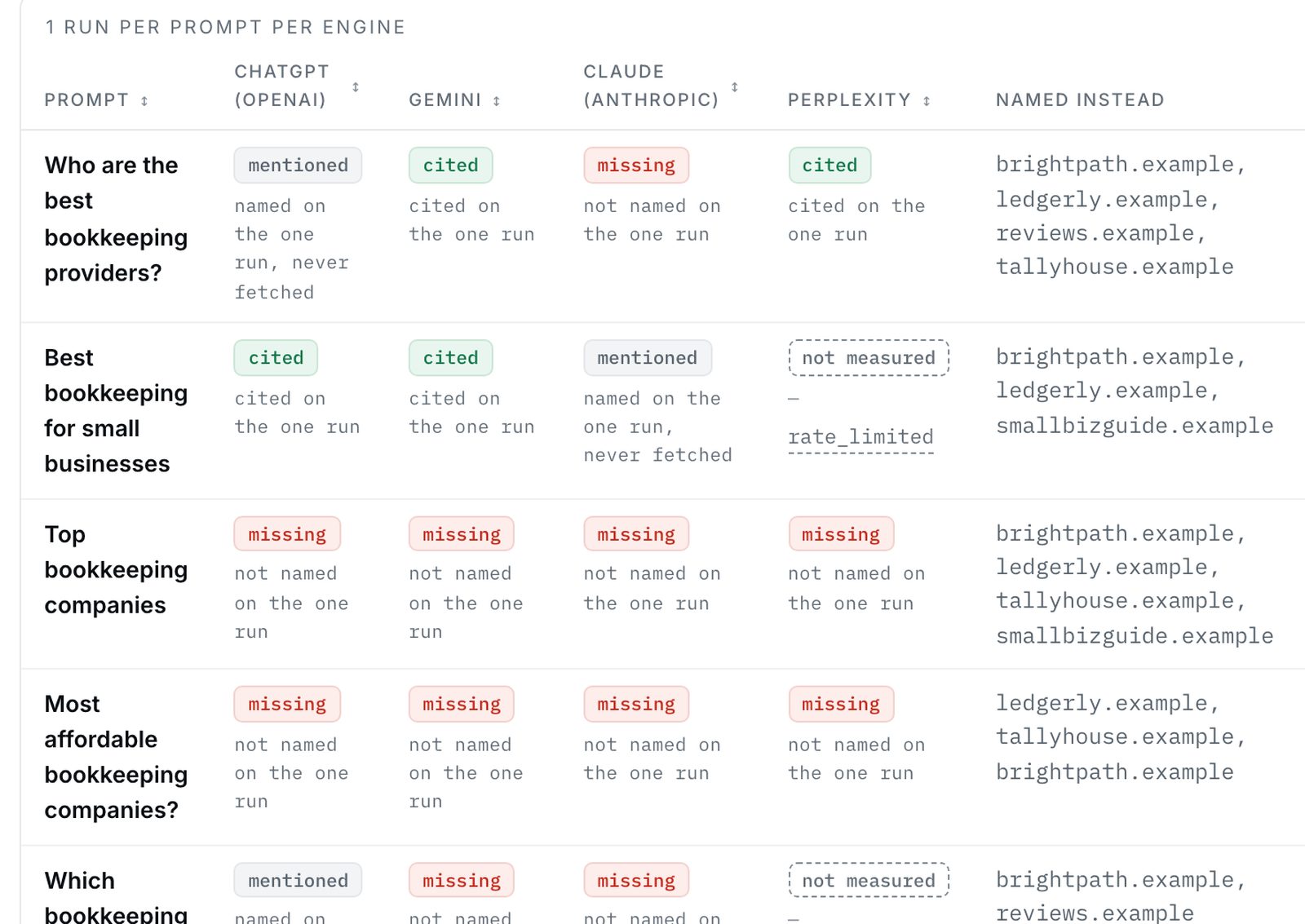
We would rather show you an empty box than a made-up number. Where a check could not reach something, the page says so.
The four results
What the four results mean
Every question in your report lands on one of these four. There is no fifth.
-
cited
Your page was used as a source
The assistant opened your website while writing the answer, and pointed at it. This is the strongest of the four: your own page did the work, and there is a link back to you.
-
mentioned
You were named from memory
Your name came up, but nothing of yours was opened and nothing was linked. Worth knowing — but no page of yours caused it, so no page of yours can be credited for it either.
-
missing
You were not in the answer
Your business did not appear at all. Somebody else has the slot, and the report tells you who. This is the one worth acting on first.
-
not measured
We could not check this one
The question never actually got asked — a check failed, or there is no honest way for us to reach that assistant. Nothing came back, so nothing is recorded against you.
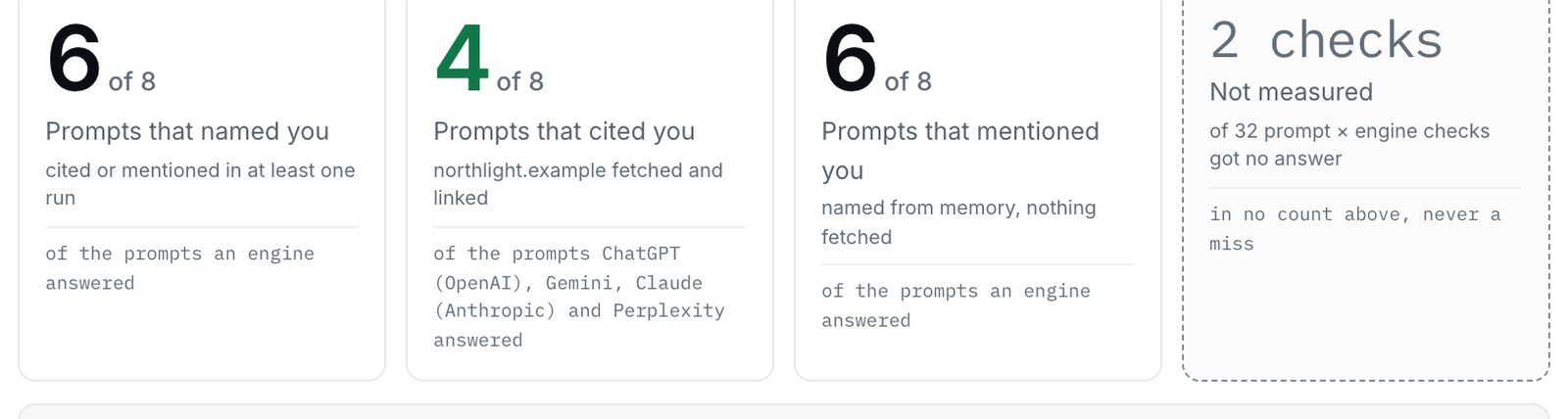
Why “we could not check” is never shown as a zero
A zero means we asked and you were not there. Not measured means we never asked. Those are two different facts, and the report never prints one as the other: a number on your report was earned, or it is not there at all.
What the report prints
not measuredwe did not ask
What it never prints
0 of 5 — struck through: never printeda count nobody earned
Repeated runs
Why we ask the same question more than once
Ask an AI assistant the same question five times and you can get five slightly different answers. That is not a fault, it is simply how they work.
Which makes a single check close to a coin toss. So we ask each question several times and report the spread — named in three runs out of five — rather than one lucky answer written up as a fact.
On the free check the rule is one pass per question, labelled as one run rather than as an average. Asking repeatedly, and watching the number move month to month, is what the paid plans are for.
Runs
1named
2named
3named
4not named
5not named
3 of 5 runs named this business. Two did not. The honest way to write that down is a spread, not a yes and not a no.
Solid — the run came back, and it named you.
Dashed — the run came back, and it did not.
Illustrative example. Not a real scan.
The rest of the record
Four more things the check writes down
Each is its own screen, and each says how much of it was really measured.
-
Who got cited instead of you
When an assistant answers and never opens your site, something else was used to build that answer. The report lists those pages — the reviews, directories and comparison sites it drew on — so you can read what they say that you do not. It is built only from answers that were really measured: a run nobody made is left out, and the leaving out is counted rather than quietly dropped. Starter and up.
-
What the assistant searched for first
Before answering, an assistant often runs its own searches. Where the engine tells us what it typed, those words are on the report, stated against how many checks reported any — never as a bare list. Where it searched and did not say what for, that is what we record: not a search that found nothing, and never a zero. On the free plan only Gemini opens your site, so on ChatGPT there is nothing to capture.
-
Google’s own AI answer
Whether Google shows an AI Overview for your questions, and whether it names you or uses your page. It is a results page rather than an assistant’s reply, so it is kept apart: never added into a scan’s counts and never averaged with them. Nothing is asked until you choose the questions, because each one costs a search at a paid vendor. Pro.
-
When an answer moves
The same question, asked again later, can come back different. An alert tells you when it does and what changed — and a difference has to survive the spread between repeated runs of the same check before it is called movement rather than noise. Pro.
The mend
What you get afterwards
Files, not homework.
-
faq-schema.json
open ↗
Your common questions, in a form assistants can quote
You paste one block of text into your site. It sets out your questions and your answers in the tidy, labelled form these systems read best.
-
organization-schema.json
open ↗
Who you are, stated plainly
Another block of text to paste in: your real name, where you are, your official profiles. It stops assistants mixing you up with a similarly named business somewhere else.
-
robots.txt
open ↗
Who is allowed to read your site
A small file you upload to your site, listing which AI companies may read it and which may not. Written correctly, so you do not lock out the ones you wanted in.
-
llms.txt
open ↗
A short summary of your site
One more small file to upload — a plain summary of what your site holds. Worth the hour it takes, though no AI company has confirmed it reads this file, and we are not going to pretend otherwise.
Those four you can make right now, free. They run in your browser from what you type in, so nothing about your business is sent to us.
What you will not get is a list of jobs to go and do. If a thing can be written for you, we write it and hand it over. Paste it in yourself if you are comfortable doing that — or forward the file to whoever built your site, where it is a few minutes of work.
{ "@type": "FAQPage",
"mainEntity": [{ "@type": "Question",
"name": "How much does review software cost?" }] }
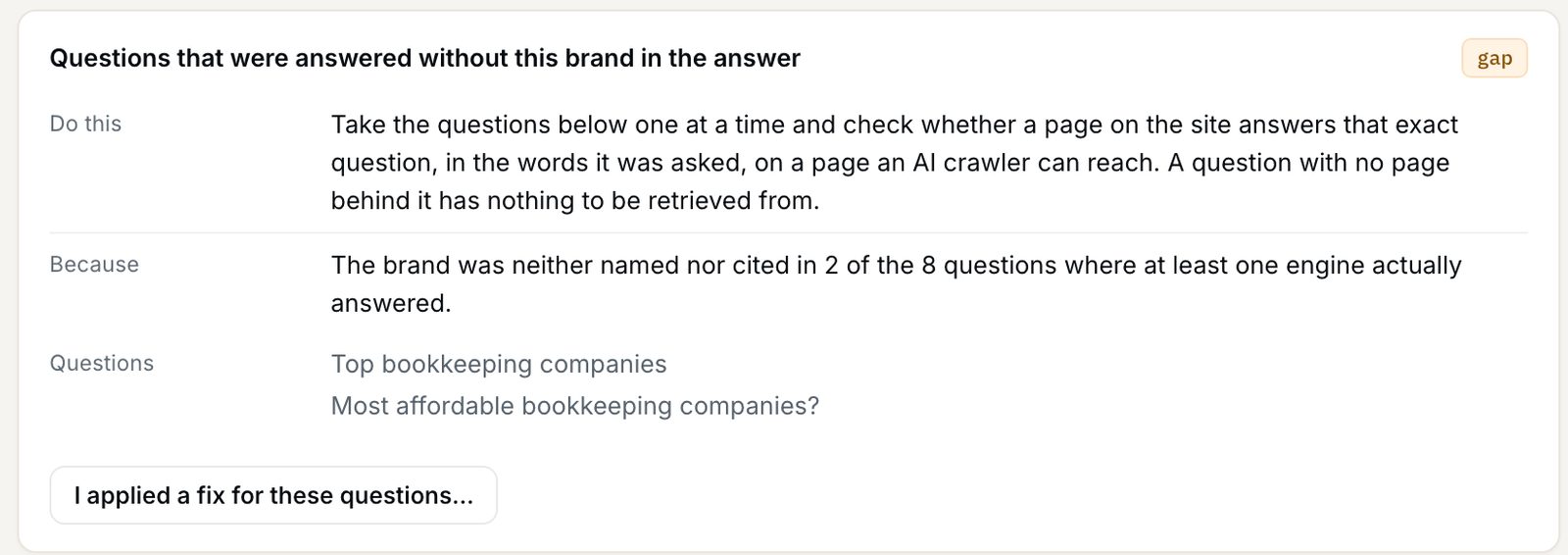
What we do not do
Three things we will not sell you
If anyone offers you any of these, ask how they intend to keep it.
-
No guaranteed mentions
Nobody controls what an AI assistant says about anybody — not us, not the assistant’s owner, and certainly not a monthly subscription. Anyone promising you a mention is selling something they cannot deliver.
What we promise
- The checks run, and you see every result, including the ones that went badly
- The files arrive, ready to paste or upload
What we never promise
- That you will be named in any answer
- That your page will be used as a source in any answer
-
No ranking claims
An AI answer is not a numbered list you can climb. It is a paragraph, written fresh each time, that either names you or does not. So there is no position to buy, and we do not describe our work as moving you up one.
What a result says
citedyour page was opened and used
What it never says
position 3 — struck through: never printeda rank that does not exist
-
No score out of 100
A single tidy number feels good and tells you nothing. It hides which questions you lost, which assistant lost them, and how many checks ran at all. We report what happened instead, even when that is less comfortable to read.
What the report prints
named in 3 of 5 runswith the two that failed shown
What it never prints
82 / 100 — struck through: never printedone number hiding all of it
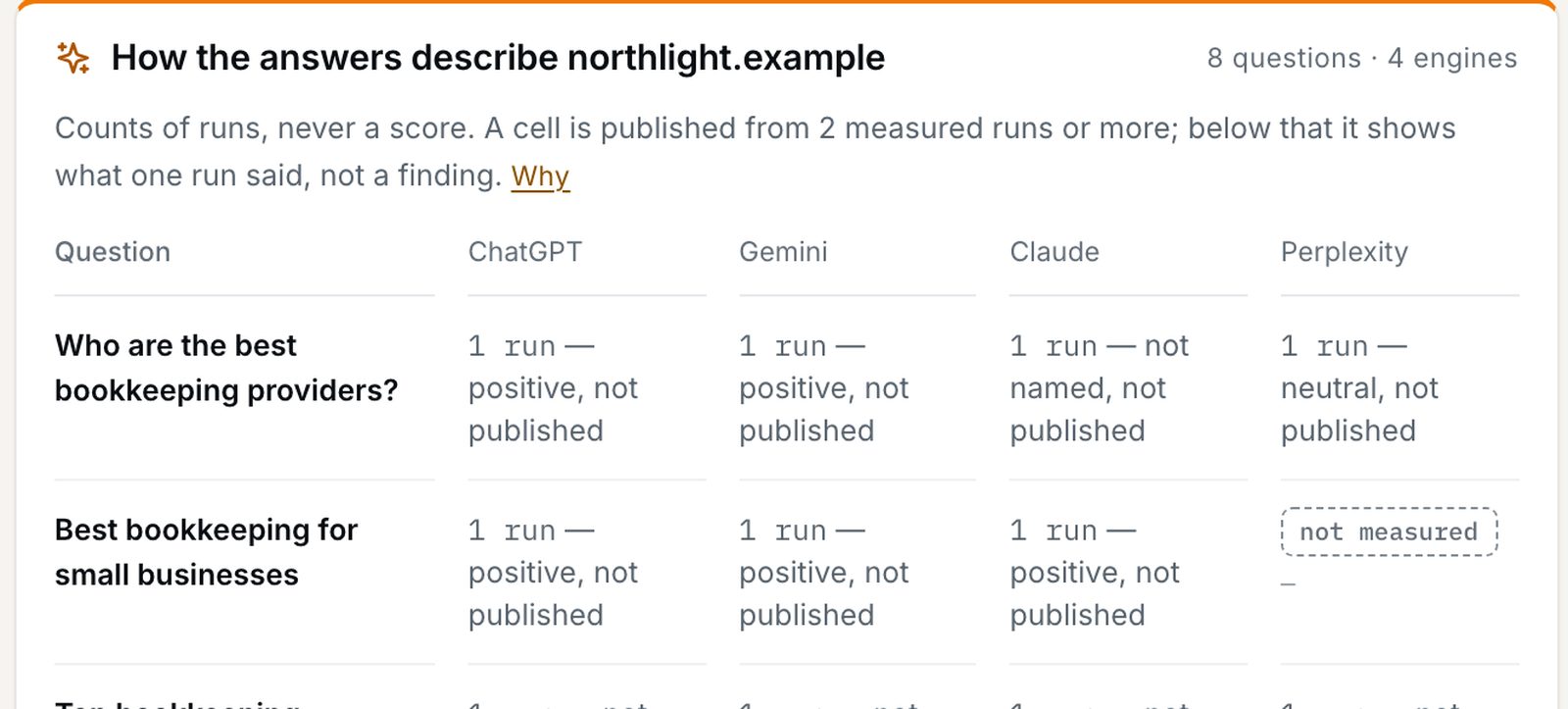

Fair questions
Short answers.
Top review management providers
ChatGPTmentioned1 of 1 run
Geminimissing1 of 1 run
Insteadcompetitor-one.com
Do I need to be technical to use this?
No. The results are written in plain sentences, and the fixes are files you can forward to whoever built your site. Nothing is installed, and nothing on your website changes unless you choose to paste something in yourself.
What is the difference between being mentioned and being cited?
Mentioned means an assistant named you from memory, with nothing of yours opened and nothing linked. Cited means it actually opened your page and pointed at it as a source. Different causes, different fixes — so we never add them together.
Why does it say “not measured” instead of zero?
Because those are two different facts. Zero means we asked and you were not in the answer. Not measured means the question never got asked, so there is nothing to count and we will not invent one.
What can I use without paying?
The four tools that make files for you are open and free right now. So are the three that look at your own website — the crawler check, the readiness score and the render check: you give one a page address, our server fetches it, and you get a real result back.
Can you guarantee my business gets mentioned?
No, and nobody can. What we can do is show you where you are missing, tell you who is there instead, and hand you the files that fix what those systems actually read on your site.
Start with the parts that run today.
Four file makers and three site checks, open on the shelf.