Free tools / ChatGPT Visibility Checker
ChatGPT, specifically
Does ChatGPT mention your business?
freeWhen a customer asks ChatGPT for a recommendation, it writes a short answer and names a few businesses — or none. Whether one of them is you is a fact you can check today. Whether it is still true tomorrow is a different fact, and this page is about both.
Check your website
up to 5 questions · ChatGPT and Gemini · asked once each
Type your website address on the checker and it asks ChatGPT and Gemini up to five questions a customer of yours would type, once each, then shows you every answer: were you named, who was named instead, and which pages the assistants used.
1
It reads your homepage to work out what you sell and where you are.
2
It writes up to five questions a customer would type — and shows them to you before it asks.
3
It puts each one to ChatGPT and Gemini once, and reads the answers for your name and for the pages they used.
The check runs on our servers, and it has to. A web browser cannot ask ChatGPT a question on your behalf. The result is yours: it is not published, not pooled into any public figure, and not used to train anything unless you separately say yes.
What it can tell you about ChatGPT
and what it cannot- Whether ChatGPT named you in each answer, question by question — a yes or a no you can read for yourself.
- Who it named instead — the businesses it recommended in your place, on that question, that day.
- Whether Gemini, asked the same questions, fetched a page of your site — the only proof that an assistant read you rather than remembered you.
- Which model answered. Each result says which OpenAI model produced each ChatGPT answer — or that the provider did not name one.
- A rank. ChatGPT has no positions to hold. Nothing here prints one.
- Whether ChatGPT read your site. On the free check it answers from memory and is not asked to search, so that cell reads not measured — never “not cited”. On Starter and Pro it is asked to search as well.
- What ChatGPT says to everyone. One run is one answer. A rate exists only across repeated asks, and the paid plans are where the asking is repeated.
Named and cited are counted over different denominators on purpose: naming over both assistants, citation only over the one that was asked to fetch. A check that did not return is left out of every count, never scored as a no.
If you searched for a ChatGPT rank tracker
There is no rank in ChatGPT. There is whether you were named, and how often.
A search engine gives every page a position, so a rank tracker has something to track: fourth yesterday, sixth today. ChatGPT does not work like that.
ChatGPT writes a paragraph. Sometimes the paragraph names three businesses, sometimes one, sometimes none — and the order they appear in is the order the sentence happened to come out, not a ranking anybody can hold on to. Ask again and the paragraph is written again. A position number for a ChatGPT answer would be a number somebody made up and then tracked.
So what any “ChatGPT rank tracker” can honestly count is narrower than the name suggests, and it comes to three things. Answermend is not a rank tracker and does not sell one; it counts these three and prints nothing that looks like a position.
Named, or not
For each question, ChatGPT either put your business in its answer or it did not. That is a yes or a no you can read in the answer itself, and it is the whole of what one run can tell you.
mentionedHow often, across runs
Ask the same question on ten days and you get ten answers. How many of them named you is a rate — named in 3 of 5 ChatGPT answers this month — and a rate needs its count beside it. The free check runs once and says so; Starter and Pro ask on a schedule and report the count.
paid plansRead, or remembered
ChatGPT can name you from what it learned in training without ever opening your website. Only a fetched page proves it read you. The two are kept apart in every result, because they need different fixes.
citedMentioned is not cited
From memory, or by searching: two different ways ChatGPT can know you
The first tells you whether ChatGPT knows you exist. The second tells you whether it can find and read your pages when it goes looking. They fail differently and get fixed differently.
ChatGPT can answer from what it already holds — text it learned from during training — or it can run a web search and answer from what it finds. A check that blends the two cannot tell you which problem you have: a business that ChatGPT has never heard of needs to become findable; a business it names from memory but never fetches needs pages that answer the question and a site an assistant can reach.
On the free check, ChatGPT answers from memory and is not asked to search. So a ChatGPT cell can read named or not named, but it can never read cited — and it never reads “not cited” either, because nobody looked, and printing a no where nobody looked would be claiming a check that was not run. Gemini, asked the same questions on the same free check, is asked to search, so the citation column on a free result is Gemini’s. On Starter and Pro, ChatGPT is asked to search when it answers, and whether it fetched your page is measured there as well.
| Plan | Is ChatGPT asked to search? | What its cell can read | How often it is asked |
|---|---|---|---|
| Free check | No — it answers from memory. Gemini is the assistant asked to search on a free check. | mentionedmissingnot measured | Once, when you run the check. A free account gets three scans in any rolling 30 days. |
| Starter and Pro | Yes — every ChatGPT ask on the paid plans is a search-backed one, so a fetched page can be proved. | citedmentionedmissingnot measured | Weekly, on a schedule, with the count of answers behind every figure. Gemini is asked daily on the same plans. |
Prices and everything else each plan includes are on the pricing page, and only there.
Why one check is a snapshot
Ask ChatGPT twice and you can get two answers
Ask “best accountant for a small online shop” this morning and again this afternoon, and the two lists can differ. A business appears in one and not the other; the order shifts; a name drops out. None of that is your visibility moving. It is the same question landing differently.
That has two consequences for anyone measuring it. First, a single result is one sample and should be labelled as one: the free check asks each question once, says so on the result, and prints a count of questions — named in 2 of the 5 we asked — rather than a percentage that would pretend to a precision one run cannot have. Second, a rate only exists across repeats: on Starter and Pro the same questions go back to ChatGPT weekly and to Gemini daily, and each figure carries the number of answers behind it, per assistant, never added together into one score.
best accountant for a small online shop
For a small online shop, a few that come up often:
1. competitor-one.com
fixed monthly fee, Shopify and Amazon reconciliation
2. Your business
e-commerce specialists, quarterly VAT included
3. competitor-two.com
cheapest of the three, software-only
best accountant for a small online shop
Two that small online retailers tend to use:
1. competitor-two.com
software-only, lowest price
2. competitor-three.com
bookkeeping plus a dedicated accountant
Two runs, two lists, one business named in one of them. Neither run is wrong and neither is the truth. The morning run is not a win and the afternoon run is not a loss; a count across many runs is what tells you where you stand, and one run is what the free check gives you — labelled as exactly that.
What the free check does
How the free check asks ChatGPT, and what comes back
You type a website address. Nothing to install, no account needed for the first look. Everything below happens on our servers and is shown to you as it happens.
AI used your page as a source
An assistant opened a page on your website and used it to answer. On the free check only Gemini is asked to look, so this is Gemini’s column; on Starter and Pro it is ChatGPT’s too.
citedNamed from memory, page not used
The assistant said your name without a page of yours in its sources. For ChatGPT on the free check this is the best outcome available, because it was never asked to fetch — being named here means ChatGPT knows you.
mentionedYou were not in the answer
The answer came back and did not name you. The useful part is who it named instead — the businesses you are being compared with on that question, today.
missingThat one could not be checked
The request did not get through — the assistant was busy, slow, or a limit was hit. It is reported with its reason and left out of every count. Never scored as a no, never counted against you.
not measuredThe signed-out check is capped per visitor per day, and the page shows the day’s shared budget of questions before you spend any. A free account gets three scans in any rolling 30 days on the same two assistants. Nothing on the free plan runs on a schedule; asking the same questions again week after week is what Starter and Pro are for.
What a result looks like
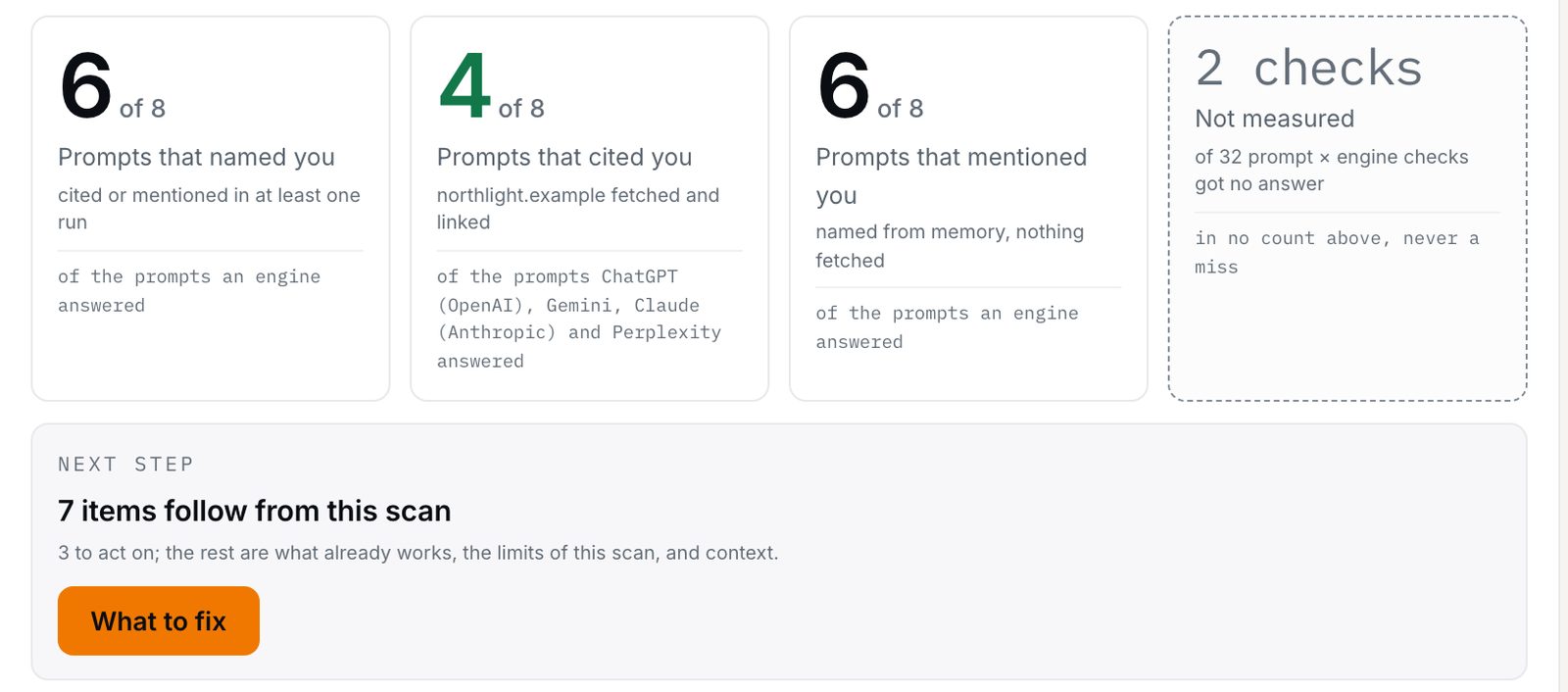
The real report screen, on an invented brand. It is a deeper scan than the free one, and the caption spells out the difference.

If you are comparing ChatGPT brand monitoring tools
Four questions to put to any tool that tracks mentions in ChatGPT
Plenty of tools will tell you whether ChatGPT mentions your brand, and some of them are good. Rather than a ranked list, here are the four questions worth asking of any of them — this one included.
Does it keep “named” apart from “cited”?
A tool that reports one number for both cannot tell you whether ChatGPT read your site or remembered it, and those are two different problems with two different fixes.
Does it show the count behind every figure?
A visibility percentage with no run count is a rate over a denominator you cannot see. Look for the count — named in 3 of 5 — and for the assistant it belongs to. Figures from different assistants asked on different days do not add up into one.
Does it say what it did not measure?
A failed request, a rate limit, or an assistant that was never asked to search should appear as not measured — never as a zero and never as a miss. A tool that fills those cells in is guessing on your behalf.
Does it say how it got the answer?
This check asks the assistants through their published programming interfaces, and each result says which model answered, or that the provider did not name one. Where a surface offers no way to ask it directly, a tool should say how it got the number rather than print one that looks the same.
Eight vendors are compared on the comparison page, every price read off the vendor’s own page and dated, with a section on when one of them is the better buy than this. If all you want is a tracking number, some of them are cheaper, and that page says which.
Fair questions.
- cited
- A page on your site was fetched and used as a source. On a free result, Gemini’s column.
- mentioned
- Named from model memory. Your site did nothing.
- missing
- The answer ran and never named you. Someone else got the recommendation.
- not measured
- The check did not return, or the assistant was not asked to look. Reported with its reason and left out of every count.
Is this a ChatGPT rank tracker?
No. There is no rank inside a ChatGPT answer to track: it writes prose, and the businesses it names, and the order it names them in, change from one run to the next. What can be counted is whether you were named, how often across runs, and whether a page of yours was used. The check counts those and prints nothing that looks like a position.
Which ChatGPT does the check ask?
It asks through OpenAI’s programming interface rather than by driving the chatgpt.com website, and each result says which model answered every question — or that the provider did not name one — so you know which ChatGPT you are looking at. It does not see ChatGPT’s shopping results: OpenAI offers no way to ask for those, so no figure about them appears anywhere here.
Why does the free check ask Gemini too, if I only care about ChatGPT?
Because the pair answers the question better than either alone. On the free check ChatGPT answers from memory and Gemini is asked to search, so together they tell you whether an assistant knows you and whether one that goes looking can find and read your pages. It costs you nothing extra: the free check is ChatGPT and Gemini, up to five questions, once each.
Does the check tell me whether ChatGPT can read my site?
On the free check, not for ChatGPT: it is not asked to search, so a ChatGPT cell never reads cited — and never reads “not cited” either, because that question was not checked. Gemini’s column carries the fetch result on a free check. Whether ChatGPT fetched your page is measured on Starter and Pro, where it is asked to search when it answers.
How often can I run it?
The signed-out check is capped per visitor per day, and the page shows the day’s shared budget before you spend any of it. A free account gets three scans in any rolling 30 days. Neither runs anything on a schedule; asking the same questions again on a schedule — Gemini daily, ChatGPT weekly — is what Starter and Pro do.
Can you make ChatGPT mention my business?
No, and nobody can. What the check gives you is where you are missing, who was named instead, and what to change on your site so that an assistant that goes looking can read you. Whether ChatGPT then names you is its decision, not ours.
Does the check run in my browser?
No. A browser cannot ask ChatGPT a question on your behalf, so the check runs on our servers and the checker page says so. Your result is yours: not published, not pooled into any public figure, and not used to train anything unless you separately say yes.
Find out whether ChatGPT names you — today, once, honestly.
The free check asks ChatGPT and Gemini up to five questions written from your own homepage, once each, and shows you every answer. No score, no rank, no card.