EXAMPLE DATA

Nothing on this screen is a measurement. “Northlight” is not a customer — it is an invented brand whose scans are simulated, in the app screenshots below (where its rivals are the equally invented brightpath.example, ledgerly.example and tallyhouse.example) and in the interactive walkthrough (where they are the placeholders competitor-one.com and competitor-two.com). Every figure comes from a fixed sample object used to render the report format. A real report carries the run timestamp, the engine responses, and the same honesty labels you see here.

AI VISIBILITY REPORT EXAMPLE DATA

Northlight example.com
app.answermend.com/scan.html EXAMPLE DATA
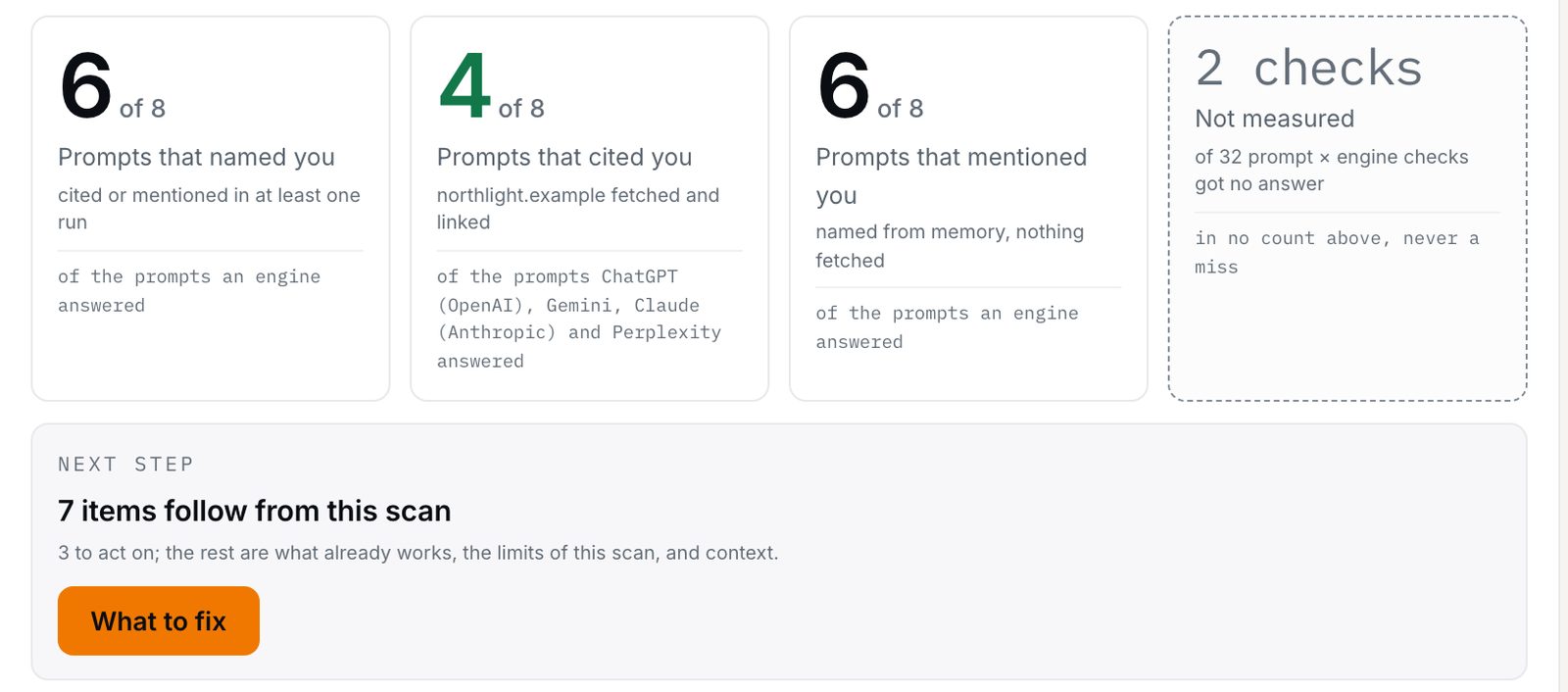
Four tiles from one example scan: 6 of 8 prompts named Northlight, 4 of 8 cited it, 6 of 8 mentioned it, each over its own denominator; a dashed tile reads 2 checks not measured of 32, never counted as a miss; beside them, a next-step card.
The scan screen as it ships — and the fourth tile is the one to read first. It is dashed, it reads “2 checks · Not measured” out of 32 prompt × engine checks, and it is excluded from all three denominators — a check that did not run is never written down as a miss, and never rendered as a zero. Each of the other three tiles states its own denominator underneath rather than assuming one: 6 of 8 prompts named Northlight, 4 of 8 cited it, 6 of 8 mentioned it. The card beside them — 7 items follow from this scan, 3 to act on — is the hand-off to the fixes screen, not a result. This capture is the app rendering its simulated example scan — eight prompts, four assistants, one run each; the interactive walkthrough further down this page renders a second, two-assistant example object, so its figures differ on purpose.
CONTROLS Not live in this preview — every control here is disabled

Headline counts

    Question × engine

    app.answermend.com/scan.html EXAMPLE DATA
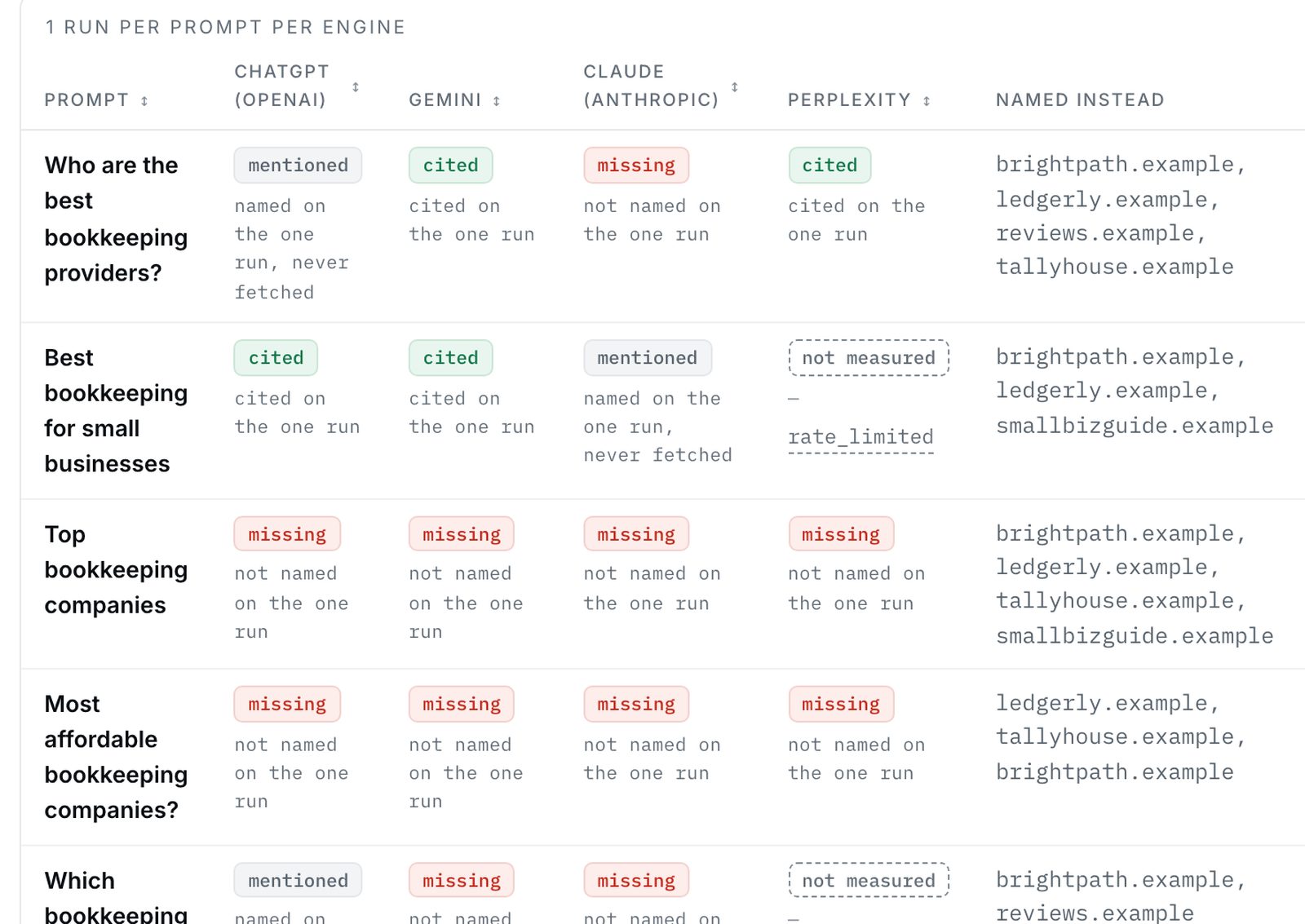
    Question-by-engine table: the first four of 8 questions as rows, ChatGPT, Gemini, Claude and Perplexity as columns, every cell a chip — cited, mentioned, missing or not measured — saying what happened on its one run, and a named-instead column listing other domains.
    Every chip carries its denominator. Each cell states the run count it was measured over — here one run per question per assistant, so a chip is a single observation and is labelled as one, because AI answers vary run to run and a count without its denominator is not a number. A check that did not return is a “not measured” chip on its own cell — the two Perplexity checks that were rate limited — excluded from the count rather than scored as a miss. Two questions, “Top bookkeeping companies” and “Most affordable bookkeeping companies?”, are missing on all four assistants. The “named instead” column is derived from the answers themselves — brightpath.example, ledgerly.example, tallyhouse.example and others, the domains the engines actually put where Northlight was not. The table below renders the same format from this page’s two-assistant, one-run example object; open any row for the per-engine detail.
    • cited the page was fetched and linked
    • mentioned named from model memory, no fetch
    • missing the answer ran, the brand was absent
    • not measured the check did not return — never scored as a miss

    Check log

    EXAMPLE DATA — one record per check. The matrix above is a pivot of these rows; nothing is aggregated that is not here.
    # CHECK ENGINE PROMPT RESULT REASON

    Share of voice — the competitive picture

    app screenshot · same simulated scan
    app.answermend.com/share-of-voice.html EXAMPLE DATA
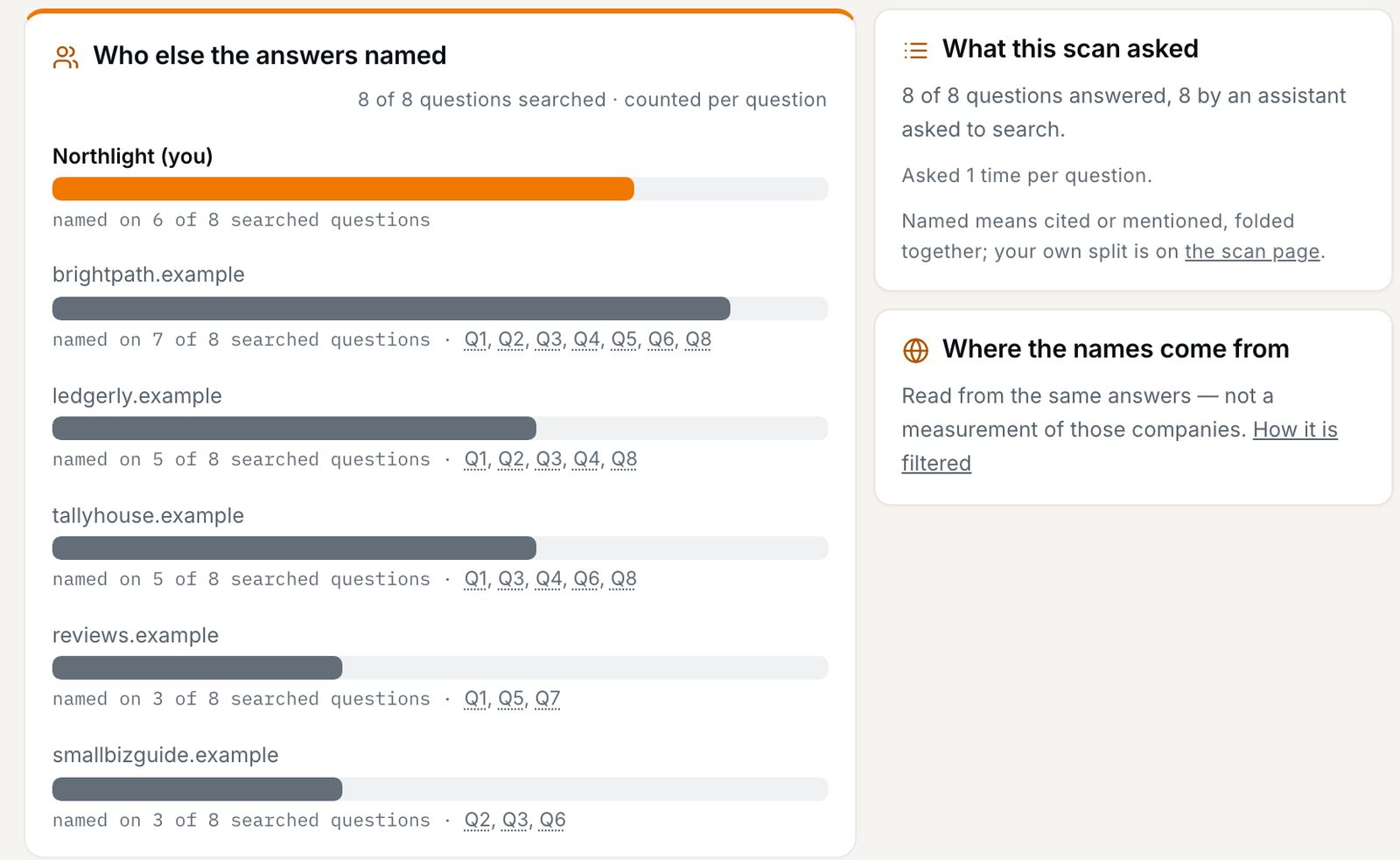
    Who else the answers named, over 8 of 8 questions searched: Northlight (you) on 6 of 8, brightpath.example on 7 of 8, ledgerly.example and tallyhouse.example on 5 of 8 each, beside panels on what the scan asked and where the names come from.
    Who else the answers named — read out of the answers, not out of a list somebody guessed at. No scan was run against these companies; they are here because the same responses this report is built from put them there, and the panel beside the bars says so. Every bar states its own denominator — Northlight on 6 of 8 searched questions, brightpath.example on 7 of 8, ledgerly.example and tallyhouse.example on 5 of 8 each, over the 8 of 8 questions that were searched — because “5 of 8” and “5 of some unstated total” are different claims. The counts are per question, not per run, and none of them is a slice of a pie: they do not sum to 100.

    What you just read

    The labels are the report.

    Everything above is rendered from a fixed sample object, and every rule it follows is a rule a real run follows too. These are the four that decide whether a number means anything.

    Example data Three labels on this screen say so, and they are in the HTML rather than drawn by script — the banner, the kicker beside the title, and the caption on the check log.
    Cited ≠ mentioned A brand can be named from a model’s memory with the site never fetched. They are separate facts, counted separately, and never summed into a score out of 100.
    Not measured ≠ zero The rate-limited check in the table reads not measured with its reason attached. It leaves the denominator; it is never written down as a miss.
    A snapshot, not a trend One pass per question, taken at one moment. AI answers vary run to run, so there is no delta on this page and no month-on-month change — a trend needs repeated runs over weeks.
    See how the scan works Four generators and three site checks · no card