Free tools / Google AI Mode
Google’s AI Mode, specifically
Google AI Mode tracking: what a tracker can see, and what nobody can
AI Mode is the mode of Google Search that answers a question in writing instead of listing results. This page is about that Google product and nothing else — and it starts with the awkward part: Answermend does not measure Google AI Mode. Not on any plan, not on any screen.
What follows is what can honestly be observed about a business appearing in AI Mode, who can observe it and how, why “rank” is the wrong word for any of it, and what this product measures instead.
What you can check here
ChatGPT and Gemini · up to 5 questions · asked once each
Type your website address on the checker and it asks ChatGPT and Gemini up to five questions a customer of yours would type, once each, then shows you every answer: were you named, who was named instead, and which pages the assistants used. It does not ask Google AI Mode, and no number it returns is an AI Mode number.
1
It reads your homepage to work out what you sell and where you are.
2
It writes up to five questions a customer would type — and shows them to you before it asks.
3
It puts each one to the two assistants through their own published interfaces, and reads the answers for your name and for the pages they used.
The check runs on our servers, and it has to. A web browser cannot ask an assistant a question on your behalf. The result is yours: it is not published, not pooled into any public figure, and not used to train anything unless you separately say yes.
What can be observed about AI Mode
and what cannot- Whether one AI Mode answer named you — on one question, on one day, from one place, signed out. That is a fact about that look.
- Which websites it linked beside that answer, and whether any of them were yours.
- Who it recommended instead — the businesses occupying the answer you wanted to be in.
- Whether it answers differently when asked again, or asked as a follow-up to the question before it.
- A rank. AI Mode writes prose and attaches links. There is no position to hold and nothing here prints one.
- A rate, from one look. One observation is a presence check. “Named in 0 of 1” is not a number, and we will not print one.
- What AI Mode shows anybody else. What appears is shaped by who is asking and where they are, so two people do not see the same answer.
- Anything measured by us. Google publishes no interface a program can use to ask AI Mode a question, so this product never asks it.
Everything in the left column comes from a person looking, or from software reading the results page a browser would have been served. Neither is a measurement through an engine’s own interface, and the two are not the same kind of fact.
Two Google surfaces, one easy mistake
AI Mode is not AI Overviews, and a figure about one is not a figure about the other
They are both Google, they are both AI-written, and they are routinely sold as the same product by tools that track one and name both.
An AI Overview is a block of AI-written text at the top of an ordinary Google results page. The ordinary results are still underneath it. The page is still a list, and the overview sits on top of the list.
AI Mode is a different thing: a mode of Search that replaces the list with a written answer and a set of links, and that takes follow-up questions, so the second answer depends on the first one you asked. A business can be named in an AI Overview and absent from AI Mode for the same question on the same morning.
And neither of them is Gemini. Gemini is Google’s assistant, it is a separate product, and — this is the part that matters for measurement — it is the only one of the three that publishes an interface a program can use to ask it a question and get a machine-readable answer back. That is why Gemini is in this product and the other two are not.
| Surface | What the visitor sees | Can a program ask it directly? | In this product? |
|---|---|---|---|
| Google AI Mode | The results list replaced by a written answer with links, and follow-up questions that keep the thread. | No. Google publishes no interface for it. | not measured |
| Google AI Overviews | A block of AI-written text above the ordinary ten results, which are still there below it. | No. Reaching it at all means a paid vendor reading the results page. | paid plansnever run live |
| Gemini, the assistant | A chat answer, which can cite the pages it fetched while answering. | Yes — Google publishes one, and grounding can be switched on per question. | citedmentionedmissing |
The third row is the honest overlap with what people search for when they search for AI Mode tracking: it is Google’s own model, answering buyer questions, with the pages it fetched on the record. It is not AI Mode, it is never labelled as AI Mode, and the difference is the whole of this page.
If you searched for an AI Mode rank tracker
There is no rank in an AI Mode answer. There is whether you were named, and how often.
A list of results gives every page a position, so a rank tracker has something to track: fourth yesterday, sixth today. An answer written in prose does not work like that.
AI Mode writes a paragraph and attaches some links. Sometimes the paragraph names three businesses, sometimes one, sometimes none, and the order they appear in is the order the sentence came out — not a position anybody can hold on to. Ask again and the paragraph is written again. A position number for an AI Mode answer is a number somebody invented and then tracked.
So what any AI Mode tracker can honestly count is narrower than the name suggests, and it comes to three things. Answermend is not a rank tracker and does not sell one; these three are what it counts on the surfaces it can reach, and it prints nothing that looks like a position.
Named, or not
For one question, on one look, the answer either put your business in it or it did not. A yes or a no you can read for yourself — and the whole of what one look can tell you.
mentionedHow often, across looks
Look at the same question on ten days and you have ten answers. How many named you is a rate, and a rate has to carry the count beside it: named in 3 of 10 looks. One look is a presence check and has to be labelled as one.
one look is not a rateLinked, or merely named
A written answer can name your business without any page of yours among its links. Being named and being used as a source are two different problems with two different fixes, and they are never added together.
citedThat second card is the one most often got wrong by tools and by us-in-a-hurry. “Named in 0 of 1” reads as a measured zero when it is one unrepeated observation, so the honest rendering is the date and what happened on it: not named on the one occasion it was asked.
How an AI Mode figure is actually produced
What third-party AI Mode trackers can and cannot see
Google publishes no interface a program can use to ask AI Mode a question. That one fact decides everything about what a tool can honestly tell you, including ours.
With no interface to ask, there are two routes left. A person looks — opens AI Mode, types the question, writes down what it said. Or software reads the page a browser would have been served, usually through a paid vendor who does that reading at scale and sells the result. Nothing else exists, and a tool that reports an AI Mode number is doing one of those two things however it is described.
Both routes share the same four limits, and none of them is a flaw in the tool:
One location, one moment
A reading is taken from somewhere, at some time, signed out. What appears is shaped by who is asking and where they are, so the number describes that reading rather than your visibility.
No follow-ups
AI Mode keeps a thread: the second answer depends on the first. A reading of one question in isolation cannot see the conversation your customer would actually have had.
It breaks quietly
The shape of a page nobody promised you is free to change. When it does, a reader that was built for the old shape returns nothing — and nothing is indistinguishable from an absence, which is a finding somebody would act on.
It is a different kind of fact
A figure read off a results page and an answer taken from an engine’s own interface are not the same evidence, and must not be printed as though they were.
spot-checkNone of that makes the exercise worthless. It makes it a spot-check: dated, located, repeated by hand if you want a trend, and labelled as a reading rather than a measurement. What is and is not measured here is written down for the same reason.
Stated plainly, because the alternative is a page that misleads
What Answermend measures today, and AI Mode is not on the list
A landing page that implies a capability its product does not ship is the worst thing this business could publish. So here is the whole list, with nothing rounded up.
Four assistants, through their own published interfaces. ChatGPT and Gemini on every plan; Claude and Perplexity added on Pro. Each question is asked once per scan, and on the paid plans the repeats come from the schedule rather than from asking several times at once — Gemini every day, ChatGPT every seventh day, Perplexity every third and Claude every thirtieth. Every figure carries the number of answers behind it, per assistant, and the assistants are never added together into one score.
Google AI Mode: nothing. No scan asks it, no screen reports it, no number anywhere in the product is about it. There is no interface to ask it through, and a reading taken off a results page is not something we are willing to print beside figures that came from an engine’s own interface.
Google AI Overviews: a screen that exists and has never run for real. Subscribers have an AI Overviews screen that reads the overview for a scan’s questions through a paid vendor, hard-capped because that vendor is metered. It has never run against the live vendor: there is no vendor key on our side, and the screen says that in one plain line rather than showing a figure. We would rather carry an empty screen that explains itself than a number nobody produced.
And if AI Mode coverage is what you are shopping for, some vendors sell it — usually as a paid add-on, and reading results pages the way described above. The comparison page says who, with every price read off their own page and dated, and says where they are the better buy than this.
What a result looks like
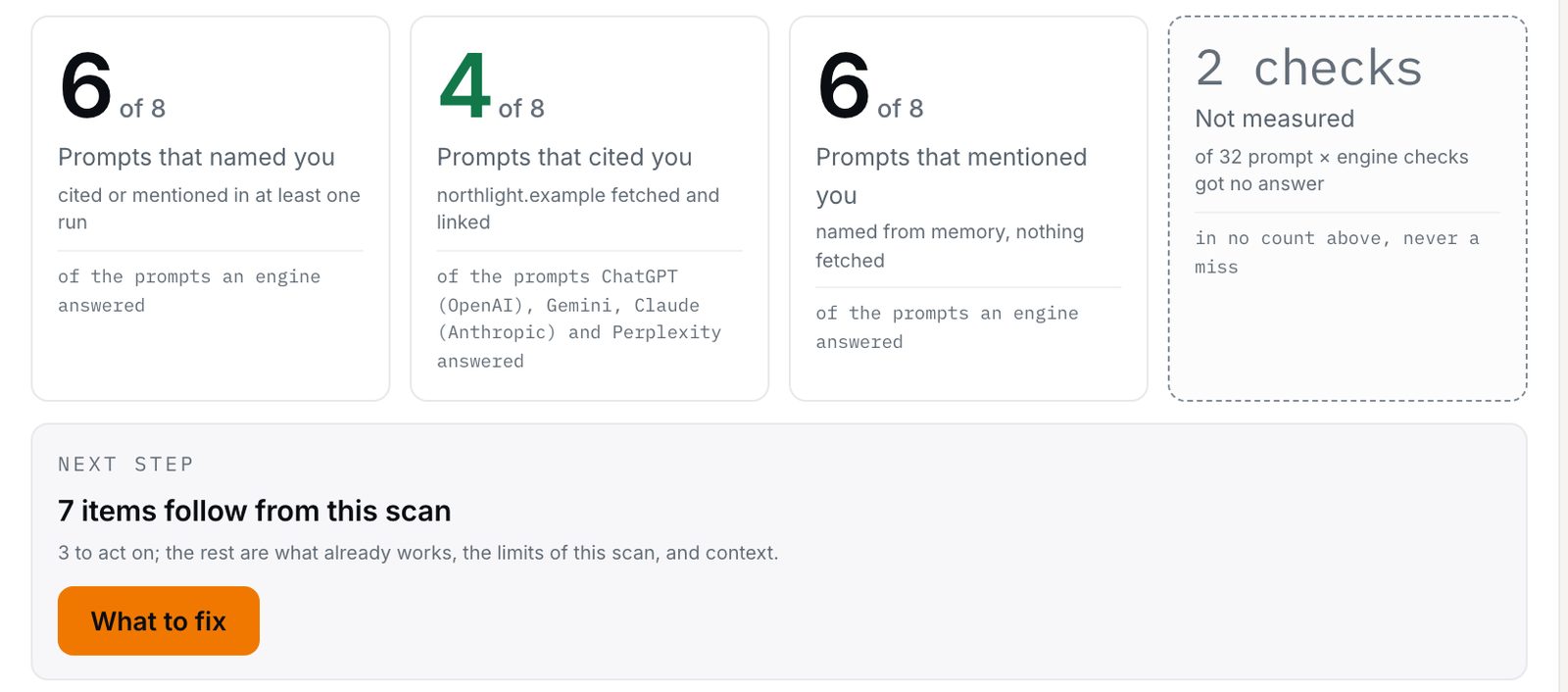
The real report screen, on an invented brand. Count the surfaces on it: there is no AI Mode tile, because there is no AI Mode figure to print.

The two honest routes
What to do about AI Mode when nobody can measure it properly
The question underneath “am I in AI Mode” is usually “does Google’s AI tell people about me”. That question has one measurable half and one that you have to look at yourself.
Ask Google’s model directly, and measure that
Gemini publishes an interface, so the same buyer questions can be put to it repeatedly and grounded, which means the pages it fetched while answering are on the record. That gives you a count with a denominator you can see: named in so many answers, cited in so many, each with the number of asks behind it.
It is the nearest measurable thing to “what Google’s AI says about my business”. It is a different surface from AI Mode and we never label it as one.
measurableSpot-check AI Mode by hand, and label it
Open AI Mode yourself, ask your five buyer questions, and write down the date, roughly where you were, and whether you were signed in. Repeat it monthly. You will have a short dated log of readings, which is exactly what the surface supports and no less rigorous than a vendor’s reading of the same page.
What makes it honest is the labelling: readings, not a rate, and never a percentage built on one look. The manual routine is written up with the recording sheet.
spot-checkBoth of those point at the same work in the end: pages that answer the question a customer actually asked, a site an assistant can reach and read, and an entity Google is certain about. None of that is specific to AI Mode, which is the quiet good news — the fixes that get you named in a Gemini answer are the fixes that give you a chance in an AI Mode one.
If you are comparing AI Mode tracking software
Four questions to put to any tool that claims to track AI Mode
Several tools sell AI Mode tracking and some of them are good. Rather than a ranked list, here are the four questions that separate a dated reading from an invented number.
Does it say how it got the answer?
There is no interface to ask AI Mode through, so every AI Mode figure is a reading of a results page. A tool that does not say so is letting you assume it asked Google directly.
Does it say where, and signed in as whom?
Two people get two answers. A reading without a location and a sign-in state attached is a number you cannot reproduce and cannot compare with next month’s.
Does it show the count behind the figure?
A percentage with no denominator hides how many looks it rests on — and one look is a presence check, not a rate. Look for 3 of 10, and for what happened to the checks that failed.
Does it keep the three surfaces apart?
AI Mode, AI Overviews and Gemini are three different products with three different ways of being reached. A tool that merges them into one “Google” score is reporting a denominator nobody measured.
Nine vendors are compared on the comparison page, every price read off the vendor’s own page and dated, including a section on when one of them is the better buy than this. If AI Mode coverage is the thing you need, that page is where to start, and this one is not pretending otherwise.
Fair questions.
- cited
- A page on your site was fetched and used as a source by an assistant we can ask directly.
- mentioned
- Named from model memory. Your site did nothing.
- missing
- The answer ran and never named you. Someone else got the recommendation.
- not measured
- Nobody asked, or the check did not return. Reported with its reason and left out of every count — which is what every AI Mode cell in this product would say.
Do you track Google AI Mode?
No. Google publishes no interface a program can use to ask AI Mode a question, and we are not willing to read its results page and print the result beside figures that came from an engine’s own interface. No scan asks it, no screen reports it, and no number in the product is about it.
What is the difference between AI Mode and AI Overviews?
An AI Overview is a block of AI-written text above the ordinary results, which are still there below it. AI Mode replaces the results list with a written answer plus links, and takes follow-up questions that build on each other. You can be named in one and absent from the other for the same question on the same day, so a figure about one is not a figure about the other.
Can anybody track AI Mode reliably?
Anybody can take dated readings of it, and that is worth doing. Nobody can turn those readings into the kind of rate a tracker implies, because what AI Mode shows is shaped by who is asking and where they are, and because its answers build on the question before. A dated log of readings is the honest shape of the evidence.
Is this an AI Mode rank tracker?
No, and there is nothing for one to track. AI Mode writes prose and attaches links; the businesses it names, and the order it names them in, change from one look to the next. What can be counted is whether you were named, how often across repeated looks, and whether a page of yours was used — and none of those is a position.
What is the closest thing you do measure?
Gemini, which is Google’s assistant and does publish an interface. The same buyer questions go to it repeatedly, with grounding on, so you get both whether it named you and whether it fetched a page of yours, each with the number of answers behind it. It is a different surface from AI Mode and is never labelled as AI Mode anywhere in the product.
Could you add AI Mode later?
Only through a paid vendor reading the results page, which is the same route everyone else uses. If that is ever added here it will be labelled as a vendor reading, kept out of the assistant counts entirely, and shown with its date and its location — the way the AI Overviews screen already is. It is not on any plan as things stand.
Why publish a page about something you do not do?
Because the question gets asked, and the answers available to someone asking it are mostly sales pages for readings dressed up as measurements. Knowing what can and cannot be known about AI Mode is worth more than a number that would not survive being questioned.
Start with the part that can actually be measured.
The check asks ChatGPT and Gemini up to five questions written from your own homepage, once each, and shows you every answer. No AI Mode figure, because there is none to give you. No score, no rank, no card.